
2011 Mazda5 MPV

2011 Mazda5 MPV

2011 Mazda5 MPV

2011 Mazda5 MPV
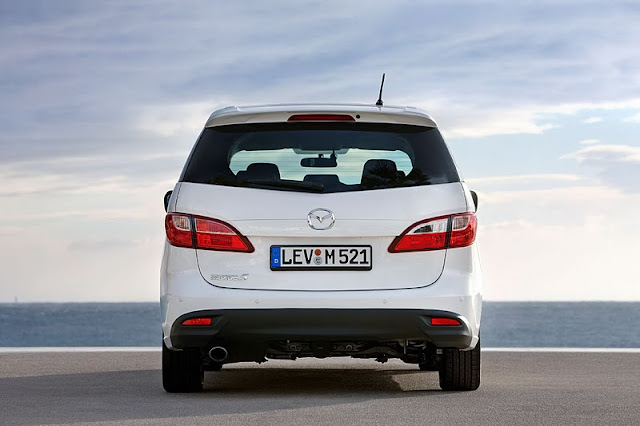
2011 Mazda5 MPV

2011 Mazda5 MPV

2011 Mazda5 MPV

2011 Mazda5 MPV


The exterior design theme revolves around  'coordinated movements', with the form and body lines transcending the look of a subcompact car. The proportions are claimed to enhance the nimble look of a car rea
 dy to leap forward. Dynamic lines tuck together tightly near the A-pillar and a distinctive character line flows from the arch of the front fender through the body's shoulder.
To distinguish itself from previous compact cars, the interior adopts a three-dimensional form that creates strong visual movement. The dashboard sweeps out and away from the front seats as it extends to the front pillars, and it is divided into upper and lower sections to create a sense space within the cabin. The contrast between the black keynote color and silver accents produces a sporty ambience, while circular details add an air of luxury.
 Mazda's Taiki concept is the fourth concept car in the Nagare design series, taking the 'flow' theme to new levels and reflecting the possible direction for the future of Mazda spo
 rts cars. The Taiki employs a front-engine rear-drive layout, a unique 2-seat configuration and Mazda's next-generation RENESIS rotary engine.
 s. The proportions of the car, a stretched coupe form with short overhangs topped by an all-glass canopy, "visually expresses the flow of air" and was inspired by the image of a pair of Hagoromo - the flowing robes that enable a celestial maiden to fly in Japanese legend - floating down from the sky.
 The second generation of the Mazda6 doesn't stray far from the successful look of the outgoing model. Though slightly longer, wider and taller than the model it replaces, its styling cues still clearly define the car as a 6.
Offered in sedan, hatchback and wagon versions in Europe, the new Mazda6 sedan features a flowing roofline that is steeper at the C-pillar and a sculptured rear end. The new hatchback however, features a  sleek roofline at the C-pillar for a coupe-like character. Both the sedan and hatchback models share the same dimensions - 4,735mm long, 1,795mm wide and 1,440mm tall - and both have the same 2,725mm wheelbase. These dimensions are effectively 65mm longer, 15mm wider and 5mm taller than the outgoing car, while the wheelbase itself has been lengthened by 50mm. The estate model has increased 75mm in length, is 15mm wider and, at 10mm, is only slightly higher than the previous model.
On the inside, the new Mazda 6 is roomier and more inviting than before. It has a higher level of quality feel with interior forms that are appealing to look at and use. Its cockpit allows the driver to feel at one with the car and it has a floating-look instrument panel to enhance the sense of roominess.

With pronounced front wheel arches and simple shut lines, the car continues along Mazda's styling theme first seen on the Mazda2. The headlamps are wholly modern in design, yet retain the company's brand character. The subtle chrome strip in the lower portion of the grille and the chrome strip dividing the front air dam into two halves are both elegant touches, while the fog lamps mimic the inner section of the headlamps.


 The Mazda Hakaze is described as a compact crossover with a roadster feel, and has been designed and modelled in Germany in preparation for the Geneva Motor Show next month. Featuring ripples in the flanks that continue surface themes set by the Nagare, the Hakaze also has a body-color wrap-over at the rear that reminds of the LA show car.
"Ryuga will combine vibrance, confidence, fun and youth...in one ingenious package," says Laurens van den Acker, Mazda's global design director. At NAIAS 2007, Mazda also will debut the 2008 Mazda Tribute HEV Hybrid SUV.


Using Mazda's unique Nagare design language, the concept car is based on an American Le Mans Series (ALMS) race car and employs the company's Courage C65 chassis and a unique 450hp three-rotor rotary engine.
"Mazda's critically acclaimed Nagare design language describes the flow of water, air, people or things moving in one direction." says Franz von Holzhausen, Mazda's North American director of design. "Mazda Nagare is flow, with an insightful and spirited styling, which, in Mazda Furai, invokes a raw, unfettered desire to possess everything this car represents."
Source: cardesignnews


The concept, which celebrates 40 years of the car maker's rotary engine and international motorsports heritage, is claimed to offer the basic proportions of contemporary race cars - measuring less than 1000mm high and nearly 2000mm wide.
Related Stories:
New Car: Mazda Furai
2008 Detroit Auto Show Highlights
cardesignnews
 Mazda has released sketches of a new compact crossover SUV concept the company will reveal at the upcoming Moscow International Automobile Salon.
 What sets this
  vehicle apart from the other concept cars in the Nagare series is that the new - as yet unnamed - car has been especially designed for the rapidly expanding Russian market.
 Mazda Motor Corporation has announced the release of the all-new Biante, a medium size minivan for the Japanese market. Relatively unknown outside Japan, the Biante is defined by Mazda's continuing ‘Nagare' design theme.
 The Biante's main design features include headlamps bleeding their boundary all the way t o the base of the A-pillar and
  merging with the DLO; a broad wing-shaped chrome extension supporting the Mazda emblem at the top part of the grille; the Japanese automakers's trademark five-point lower grille and long, vertical side fog lamp/intake flanking the bumper fascia, the latter expressing athleticism and stability. Large vertical reflectors located under clear bezel lamps built into the sides of the rear bumper are other unique styling details.
Offered in three different trims levels - 20CS, 20S and 23S - the Biante will be available with 2.0-liter and 2.3-liter engines and a choice of front-wheel-drive and four-wheel-drive.
Source : cardesignnews
 As we reported in June, Mazda has now confirmed it will unveil a compact crossover vehicle concept at the Moscow International Automobile Salon on 26 August.
 roof line gives the design an emotional appeal. Riding on large 22-inch wheels, the Kazamai's compact dimensions are given enhanced sporting appeal.
 Mazda has officially taken the wraps off its Kazamai crossover concept today at the Moscow International Automobile Salon. As we reported back in June and subsequently in July of this year, the concept has been specifically developed for the growing Russian market - now the largest car market in Europe.
 passenger concept has a wheelbase of 2780mm - roughly the size of the current Mazda3. Developed following a ‘crosswind' theme, the body features flared wheelarches and a wedge-shaped profile, designed to 'evoke the image of a sleek arrow cutting through a mighty wind'. The design is also intended to express the agility and dynamism of wind gusting along the side of the vehicle.
 Mazda has released these images of the Kiyora compact urban concept car the automaker will reveal at the 2008 Paris Motor Show. Based on an all-new platform designed to maximize weight reduction, the Kiyora is claimed to represent the harmony between driving pleasure and environmental and safety features.
 These are the first images of the new Mazda3 sedan, set to make its public debut at the Los Angeles Auto Show in November. This is the first complete redesign of the Mazda3 (known as Mazda Axela in Japan) since its introduction five years ago.
 ent
ent  developed for heightened exhilaration'. The newest iteration of Mazda's sports compact aims to push forward the heritage of Mazda and the pedigree of the current Mazda3, which accounts for almost one in three sales for the Japanese carmaker annually.